Archive

Posts Tagged ‘Lecture’

BGF 2011 recap

November 20th, 2011 No comments

Last Friday and Saturday the Browsergames Forum 2011 was held in Offenbach, Germany. As you can guess from the name of the conference it’s all about online games run in the browser with free-to-play being a big part of that equation.

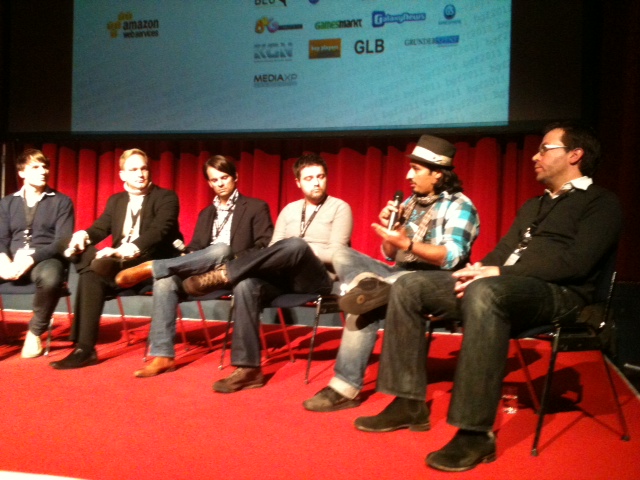
I attended BGF last year with a talk about the qualities of virtual goods. While I didn’t have enough time beforehand to prepare another talk this time I was fortunate enough to sit on a Panel about the future of F2P monetization with:

  • Christian Godorr (Bigpoint)
  • Henning Kosmack (MegaZebra)
  • Egge Diercksen (Mail.ru)
  • Janis Zach (Sponsorpay)
  • Dirk Weyel
  • and moderated by Mark Gazecki (Honeytracks)

I was quite happy with the panel and would have loved to focus even more on the potential developments in the F2P marketplace. I felt like we barely got started when we were already running out of time.

Apart from sitting in the panel I spent most of the time talking to old (and new) friends and colleagues. And if I wasn’t doing that I sat in the other talks and panels and tweeted as much as I could. So from the huge flood of #bgf2011 tweets, here are a few choice moments. Be aware that this is me reiterating what the presenters showed or talked about – there is room for error in there.

Future Trends in Social Games
Jussi Laakonnen – Applifier (@jussil)

  • Slideshare Slide Deck
  • Global gaming market advertising and virtual goods revenue prediction shown up to 2015, at which point 50% of all revenue is in facebook.
  • As market contracts indies have to band together to succeed while keeping control of their own assets.
  • Farmville allows you to find ingame friends that are not facebook friends. This is the Interest graph in contrast to the Social Graph.
  • This means: avatars vs. real identity. Social game companies try to get their own data aside from facebook.
  • Social graph = higher ARPU because of better retention and engagement.
  • Communication among strangers (Interest Graph) may alienate regular casual audience: “Soccer moms don’t like being teabagged” What about anonymity?
  • Googles only chance of making Google+ work is to win as a mobile social network.
  • Valve will probably soon pop up on Android with Steam…

Next Generation of Online Games – Social and Core
Ilkka Paananen – Supercell (@ipaananen)

  • Gunshine: By making the game harder the Monetization increased, as did satisfaction with users and retention went up
  • Typical Gunshine player: 30min session, 4 times a day, 10 active friends.
  • Social 2.0: users are *playing* with each other (not necess. synchronous) and making new friends
  • primary monetization drivers of #Gunshine: Boss Battles, PvP #bgf2011

The Settlers Online – Key Learnings of Year 1
Christopher Schmitz & Benedikt Grindel – BlueByte

  • “With a large amount of data a fool can justify anything”

Creation and Marketing of Browsergame IPs
Markus Büchtmann – ProSiebenSat1digital

  • ~60% of people agree that branded products are of higher quality than unbranded products.
  • Pro7 Games uses voiceover actors famous from related media products in their ads. For example: german Liv Tyler (Lord of the Rings actress) dub actor for fantasy game ad…
  • Tv ads have IMMEDIATE effect on number of registrations: people have laptop/mobile device right next to TV (or watch on pc?)

The future of f2p?
Teut Weidemann – BlueByte

  • Teut quotes Heiko Hubertz: next 5yrs. Traditional publishing model, mobile and beowser converge,market crunch, users switch games often
  • Teut quotes Jessica Mulligan: higer consolidation, indy still possible, connected gaming more prominent, subscription for AAA MMOs
  • Teut quotes Andreas Weidenhaupt: platforms willbe irrelevant, F2P will be dominant biz model, Web Games will look like retail.
  • Teut quotes Michael Zillmer: all online games will be in browser. CPA will be > LTV. CRM more important. Main growth limit is HR.
  • Teut quotes Ralf Adam: mobile connectedness = key factor. Localization key multiplier. Budgets will rise but cap.
  • Teut quotes himself: saturation still 3-5 yrs away. Users are key(finding, keeping,crm,communities,roi important)
  • Rift is designed with a backup transition to F2P already in mind.
  • China is 5yrs ahead in F2P: user has too much choice Lack of content means users switch = drive to add content (6 mo at start)
  • If COI rises, why not pay users to play our games? Online poker sites basically do that already

Panel: IP and browsergames – opportunities and pitfalls
Ralf Adam (Travian Games), Antony Christoulakis (Keen Games), Philipp Reisberger (Bigpoint), Jan Wagner (Cliffhanger Productions), Malte Barth (Iconicfuture) moderated by Heiko Klinge (Making Games Magazine)

  • Antony: box product license simpler. Service model means contracts are more difficult.
  • Ralf: just a limited number of IPs put there that make a good fit for games.
  • Jan: sick of the dev-publisher model. No more. Spent company savings on shadowrun license (which is not AAA class).
  • Jan: but company is small enough to be profitable with only a six figure user number. That is reachable with Shadowrun
  • Malte: IPs are an argument when talking to VCs because that is something these non-techies know. But will look at terms closely.
  • Jan: Game IPs are tough because audience knows what kind of game they want (unlike movies, pen and paper…)
  • Philipp: getting approval for faces from female battlestar actors was harder than getting approval for ships from the company.
  • Malte: IPs take too much time to sort out, not compatible with short dev and tech cycles. Instead maybe branded virtual goods.
  • Ralf: Movie IPs are great for retail products: Release concurrent with premiere. Service games outlast movie popularity.

Analytical Creativity in Game Design
Christian Godorr & Stephanie Hels – Bigpoint

  • First step was to have weekly meetings with all people to talk about what is happening in the game so everyone is in the know. Both qualitative and quantitative reports.
  • Challenge with Drakensang: Low ARPPU for a core game. Figured out events increase that specific KPI
  • Farmerama challenge: lifetime is unsatisfying. Events work, but Crafting adds depth. This leads to animal breeding mechanics.
  • Farmerama user lifetime approaching more core-based game user lifetime. Nice! Good job, guys!
  • When improving ARPPU first focus on high monetizing users so they have more cool stuff without breaking game for others. #bgf2011 #bigpoint

Non-Competetive Game Content
Kathleen Kunze – InnoGames

  • What is the challenge in Farmville? Why do players play farmville, when there is none?
  • Her theory: someone looks for a game that fulfills the needs (maslow’s hierarchy) that are not fulfilled in real life.
  • Not all challenges are competetive! Riddles, growing plants, cooking, making music…
  • Competetive content is not useless for non-competetive players: Medic, Healer is involved but wants to help, not kill.
  • Meaning/quality of the result needs to be important to the non-competetive player nonetheless.
  • You cannot satisfy everyone but you can open new audiences and expand the game.

And there you have it, my slice of the BGF talks. In general it seems that the topics mobile games and the interest graph were pretty important. Let’s see where they are at next year.

GDC Europe: Big Bucks for Bits and Bytes PDF Download

August 19th, 2011 No comments

Just a few days ago I held my GDC Europe lecture called Big Bucks for Bits and Bytes – a holistic approach to monetization. I’ve spent a lot of time preparing and was quite happy with the result. The slides are now available on my slideshare account. You can download them from there or watch the slides online.

Title Slide
Click the image to see the slides.

The slides are released for personal use only. If you have questions, need further information or plan to use the presentation for anything other than personal use, please get in touch with me.

Lecture at GDC next week

August 13th, 2011 No comments

Next week it’s again time for GDC Europe, this time with me as a speaker. Contrary to what you’d expect from the name of this blog though I won’t be talking about digital spaces. My lecture is called Big Bucks for Bits and Bytes – a holistic approach to monetization and it’s the culimnation of my 2 years with gameforge and the many thoughts and learnings about free-to-play monetization.

If you’re in Cologne feel free to drop by and say hello. I will be talking on Wednesday after lunch starting at in the Rheinsaal on the 1st level. If you can’t make it, then check out the sneak preview below. Once GDC is through I’ll also most likely make the entire presentation available on Slideshare and here on this blog.

Title Slide
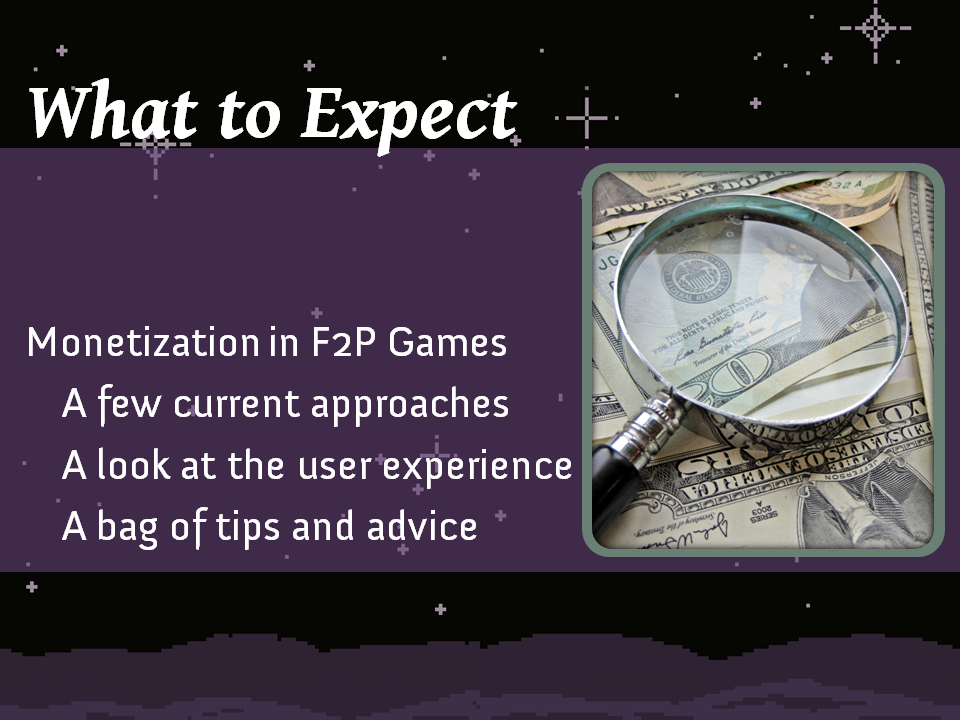
What to Expect
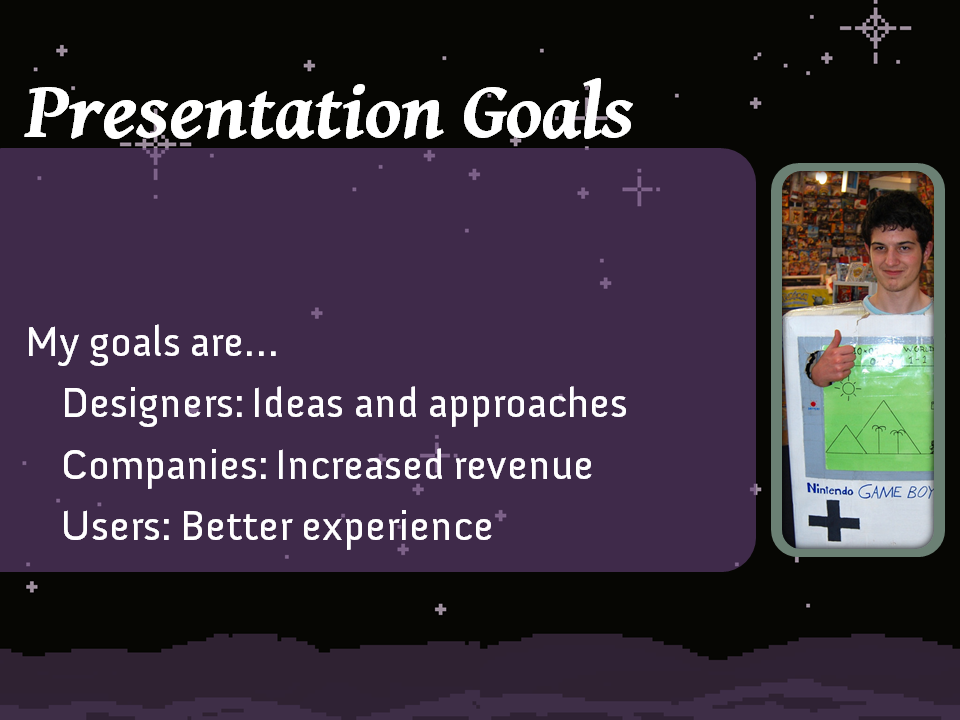
Presentation Goals

Categories: Video games Tags: , ,

Storyworlds across Media conference

July 22nd, 2011 No comments

A few weeks ago I was at the Storyworlds across Media conference at the Johannes Gutenberg University in Mainz, Germany. This academic conference revolved around the creation of fictional universes and settings (storyworlds) through a variety of media. This conference was my first real contact with academic narratology and it was most definitely inspiring and interesting.

Over the course of three days I got to meet a set of interesting and intelligent people and talk about a intruiging topics. Of course there also were a number of papers being presented, some of which were quite intriguing while others were rather dry. Videos of all talks are supposed to be made available at the website, free of charge, later on. I’ll briefly try to highlight the, in my opinion, most valuable sessions so that you can give them a look once the videos are online.

Storyworlds across Media
from Marie-Laure Ryan

This introductory talk providfed a good overview over the idea of “storyworlds” and how they fit into theories of narratology. This lecture was a great start to the conference for someone new to the academic discourse on this topic. One of the things I specifically scribbled into my notes was her list of “constituents of storyworlds”, e.g. the things that together can create a storyworld:

  • An inventory of existents
  • A space with certain geographic features
  • Physical laws
  • Social laws and values
  • Events. A history of changes that happen in the narrative
  • Mental events

What I found especially interesting is that she specifically points out the fictional geography of storyworlds and it’s importance.

A Game of Thrones: Transmedial Worlds, Fandom, and Social Gaming
from Lisbeth Klastrup and Susana Tosca

These two discussed a few transmedial events surrounding the launch of the Game of Thrones TV series, specifically the online games. They made a few interesting observations when it came to the different target groups, how they overlap and interact. Using some low-fi data mining they tried to figure out how readers, GOT enthusiasts, gamers and other people interlocked.

The Developing Storyworld of H. P. Lovecraft
from Van Leavenworth

A lecture dealing especially with the slightly odd nature of the Cthulhu mythos and it’s reincarnation in different “texts”. There are a few peciularities since the IP is no longer copyrighted and there is a wide range of different authors. It seems that it’s more of a brand that implies that the text provides a certain sense of world, unifying themes and returning elements. The latter could be locations (Arkham…) or characters (old ones…) but don’t have to be.

Strategies of Storytelling on Transmedia Television
from Jason Mittell

This lecture delved into different methods of sharing the storyworld of a series outside of the TV show. Jason explained two fundamentally different approaches using the examples of Lost and Breaking Bad. The former is expansionist, where the transmedial material expands on the world an adds new histories, characters and events. The Breaking Bad material on the other hand aims to “fold in on itself” to provide denser information about the character themselves, to help viewers get into their heads.

Jason also noted that there are three different kinds of tie-in games to movies and TV shows:

  1. Exploratory: These games allow you to explore the fictional storyworld yourself.
  2. Imitational: Games that allow you to “try on the skin” of the story characters. These often fail because the expected drama from TV and Movies is missing.
  3. Narratively: Games that try to retell the story of the movie in the game. This is almost never done for TV shows. Here the approach is usually to have the game be “one extraordinary episode”.

The Paradox of Interactive Tragedy: Can a Video Game have an Unhappy Ending?
from Jesper Juul

Here Jesper took a closer look at the elements that make up a tragedy and why it’s so difficult to recreate that in games. His theory is that this lies within the paradox of failure. Usually, when we as players succeed in some task within the game, we are happy, as is the protagonist. Likewise, when we fail we are frustrated and suffer, as does our protagonist. In Tragedy however we need to delight at the failure and misfortune of the protagonist. Our long-term aesthetic desire for a well-rounded story has to overcome our short-term desire for the protagonist to succeed, something that’s quite strong in video games.

Experiencing Environments PDF Download

April 16th, 2011 2 comments

I’ve finally held the lecture mentioned in my last post. I was pretty happy with the results and since I wanted to share the slides with my readers I’ve just uploaded them to slideshare. You can download them from there or browse them here.

The slides are released for personal use only copyrighted under the Creative Commons Attribution-NonCommercial-NoDerivs 3.0 Unported License. If you have questions, need further information or plan to use the presentation for anything other than personal use, please get in touch with me.

Experiencing Environments lecture

April 9th, 2011 2 comments

For the last couple of weeks I’ve been collecting material and planning my upcoming lecture at the International Film School in Cologne.

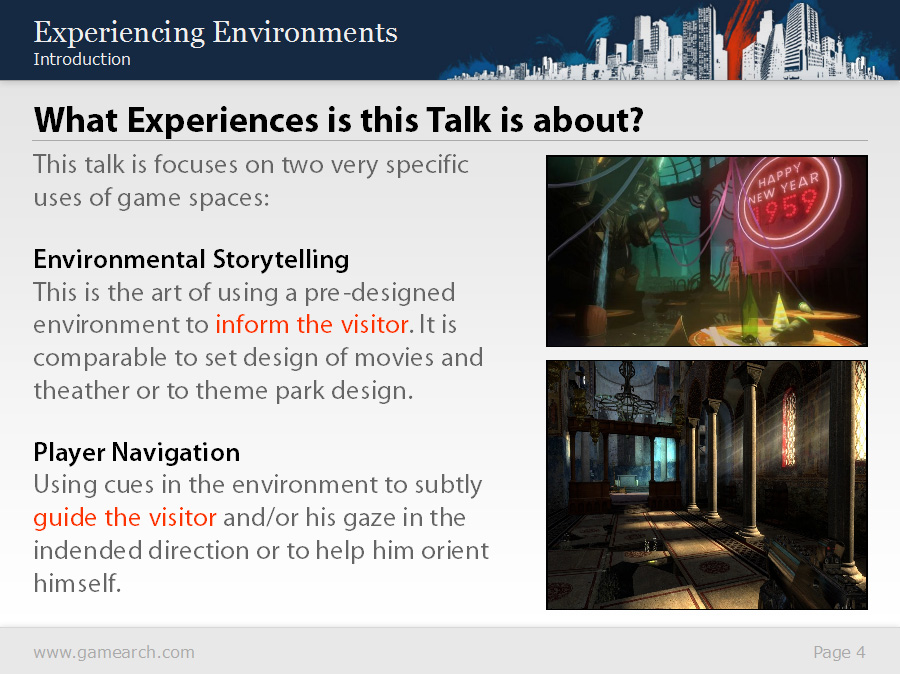
Today I’m finally sitting down to really flesh it out and as a little teaser I’ve uploaded the opening image and an introductory slide. As you can see there the lecture is called Experiencing Environments.

It is about level design focuses on the topics of environmental storytelling and player navigation. The latter will mostly be information from my No More Wrong Turns article but the former is mostly new material compiled for this lecture.

Of course, once everything is done, the lecture is held and any possible feedback is incorporated I will upload it here to share with the greater gaming community.

In the meantime enjoy the previews and if you do have any additional material or interesting links on the topic, feel free to send them my way – there’s always room for more!

Qualities of Virtual Goods PDF Download

November 9th, 2010 4 comments

I’ve gotten a lot of requests to release the slides from the Qualities of Virtual Goods presentation that Volker and I held at the Browsergames Forum 2010. So now that I’ve cleaned up the slides some I can make the available as a handy PDF download:

The article is released for personal use only and it’s copyrighted by Gameforge Productions GmbH. The exception are the images licensed under Creative Commons and clearly attributed. If you have questions, need further information or plan to use the presentation for anything other than personal use, please get in touch with me.

“Qualities of Virtual Goods” @bgf2010

November 6th, 2010 3 comments

Just got back from the Browsergames Forum 2010 and it seems like the presentation from Volker and me was a success:

We’ve had a packed room, even though it was too hard to find and not really in the schedule. The talk itself went really good, even though the handheld microphone was a bit of a bother. And then after the talk we got lot of positive feedback from the audience, through twitter and all through the rest of the forum. I’ve even had someone compliment me on the talk in the men’s room.

Right on.

As for the talk: I’ll be putting the slides up shortly. We’ll have to adjust a few things first. Watch this space for the download coming sometime in the next few days.

Browsergames Forum Talk (+ more GDC)

October 21st, 2010 4 comments

The Browsergames Forum in Frankfurt, Germany will be in a few weeks (on November 5th adn 6th to be precise) and I’ll be there with a short talk on the topic of monetization. I’ll be speaking with my MMO colleague Volker Boenigk and the title of our talk is “Qualities of Virtual Goods”. It’ll run for about 25 minutes and you will be able to catch us on Saturday, the 6th November at 10:30. I’ll use the opportunity to take one of the segments of my planned GDC 2011 talk and present it to an audience. To give you an idea of what we’ll be talking about, take a look at the abstract I’ve sent in to the conference organizers.

This talk will present the audience with a system of attributes that most Virtual Goods possess. The chosen properties are primarily responsible for the users’ perceived value of an item and can directly be affected by the game design and visuals. Knowing about this system and the attributes is the first step in systematically improving the value of your items and overall repository of premium services.

By examining how this system applies to our daily business at Gameforge we will give some practical advice on real world application. To top off the talk, we will be using the developed properties as a foundation for some tricks and methods to improve the monetization of your own free-to-play game.

And having mentioned the Game Developers Conference talk above here’s a small update on that topic: Unfortunately my submission for the Main Conference was declined (*sad face*). However I’ve resubmit my proposal for the Social & Online Games Summit and I’m hoping that there’ll be some room for me in there. (*happy face*) Wish me luck.

Categories: Video games Tags: , ,

GDC2010: Day 1

March 10th, 2010 6 comments

So, the official part of Day 1 is over. I’ve spent most of the day listening to the various lectures of the Social and Online Games Summit. Roughly half of them have been very good and interesting, the other half was so-so.

Indies and Publishers: Fixing a System That Never Worked
I actually spent the first 20 minutes or so in this Indie Games Summit lecture. Ron Carmel of 2d Boy (World of Goo) was speaking and since I was so fascinated of his opening talk last year, I decided to give this one a try.

Unfortunately the talk didn’t do anything for me. Ron simply presented the traditional publishing model and contrasted it with indie development. Then to fix the problems of Indie Development (lack of funding) he presented the recently announced Indie Fund.

While I love the idea and concept of the Indie Fund, the lecture just seemed like an ad for the fund, which was a sort of turn off for me. I got up and left during the Q&A session.

How Friends Change Everything
I then went over to this keynote lecture by Gareth Davis of Facebook who talked about the platform and it’s relevance for gaming. Even though I missed the first half of it I still enjoyed it. Unfortunately I have made no notes but I’m sure it’ll be well covered by the blogosphere. Either way, the lecture was interesting, even if far from groundbreaking. Still nice to get a look behind the scenes at the monolith that is Facebook.

What Virtual Worlds Can Learn From Social Games
Next up was this lecture. The first one actually held by designer: Sulka Haro of Sulake, the makers of Habbo Hotel.

There were some interesting tidbits there, such as using the six different playstyles as defined by Mildred Parten to look at Social Games. This makes it clear that Social Games as we currently know them are mostly about the parallel play. People can’t really play with each other, instead they play “next to each other”.

Another thing was that the speed and responsiveness of an application can have a tremendous impact on retention and conversion rates. Habbo started out as a Shockwave plugin that was eventually moved to Flash for the much larger install base (98% vs 40%). This also sped up the performance of the app and led to +7% retention rate and +5% user conversion. Somewhat surprising that this has such an impact.

Sulka also talked about the advantages of the Facebook platform. An obvious one that nevertheless never crossed my mind is that there is no risk to lose users to forgotten user/pass data. How often do you just create an account out of impulse and then you forget which login data you used? Propably happens more often to your potential users than you’d think.

The last thing I want to point out was a little bit about the “placeness” of social games: In many games it doesn’t seem to be necessary. FarmVille has a game space but it’s not really used by the game. All that happens is the avatar walking around – and even that is best prevented by the players. There isn’t really a lot of justification to have such a game space. I kinda liked that statement because I am pretty much of the same opinion.

Why Are Gaming Veterans Flocking To Social Gaming
This roundtable was moderated by Noah Falstein (The Inspiracy) with Brian Reynolds, Brenda Brathwaite and Steve Meretzky speaking.

The four were talking on the topic and it was interesting to listen to them talk. All of them were attracted to the Social Game space by shorter development cycles, smaller teams and a sort of “pioneer spirit” as I’d call it.

Aside from that it was a great panel but not really something where I took a lot of notes. The only point I did write down was the argument about complexity: Will Social Games become more complex?

What was interesting about the answers was that there was a solid 50/50 divide. Two interesting arguments in this old debate that I want to repeat were: To keep gamers interested the game has to produce new content, sometimes in the form of new game mechanics. This layering will undoubtedly make games more complex. The other side of this is that the more complex these games get, the harder it is for them to lure new players in since there’s too much stuff to know and handle.

What Social Games Can Learn From Virtual Worlds
This lecture was held by Michael Goslin of Hangout Industries and definitely one of my favorites of the day. The talk was focused on the two key things that VWs/MMOs do better than Social Games: User retention and monetization.

According to Michael, retention is based on the following factors:

  • Player investment in the world
  • Deep content
  • Fresh content
  • Service
  • Concurrency (People playing simultaneously)
  • Community

He then elaborated on these points. I don’t have notes on this but I’ve taken pictures of each of these slides. I hope most of it is self explanatory:

Succeeding with Licensed Brands in MMOs and Virtual Worlds
This was the last talk of the day. Another roundtable, this time led by N’Gai Croal. Four licensors/licensees talked about their experiences with developing a licensed game.

The panel was alright, although a little generic at times. The key ideas though were: The approval process of the Licensor is generally in contrast with the need for constant, timely updates to keep the game fresh.

MMOs are services and monetized over a longer period of time. To have paying users, you need to retain them, which requires a quality experience. This is often at odds with the fixed deadlines as they are common in IP-based game development: Movie Games need to be finished and released by the time the movie hits the theaters.

So that was it for my first day. I’ll hopefully tell you all more tomorrow.

Categories: Video games Tags: , ,